A Practical Guide for Shopify Merchants and Compliance Solutions
As AI assistants evolve from answering questions to completing purchases on our behalf, the privacy compliance landscape is shifting beneath our feet. Here's what merchants and compliance solutions need to know - and do - right now.
The Checkout That Never Visits Your Store
Picture this: A customer asks ChatGPT to find running shoes under $150. The AI researches options, compares prices, recommends a pair from your Shopify store, and completes the purchase - all without the customer ever opening your website.
No storefront visit. No cookie banner. No consent popup.
Welcome to agentic commerce.
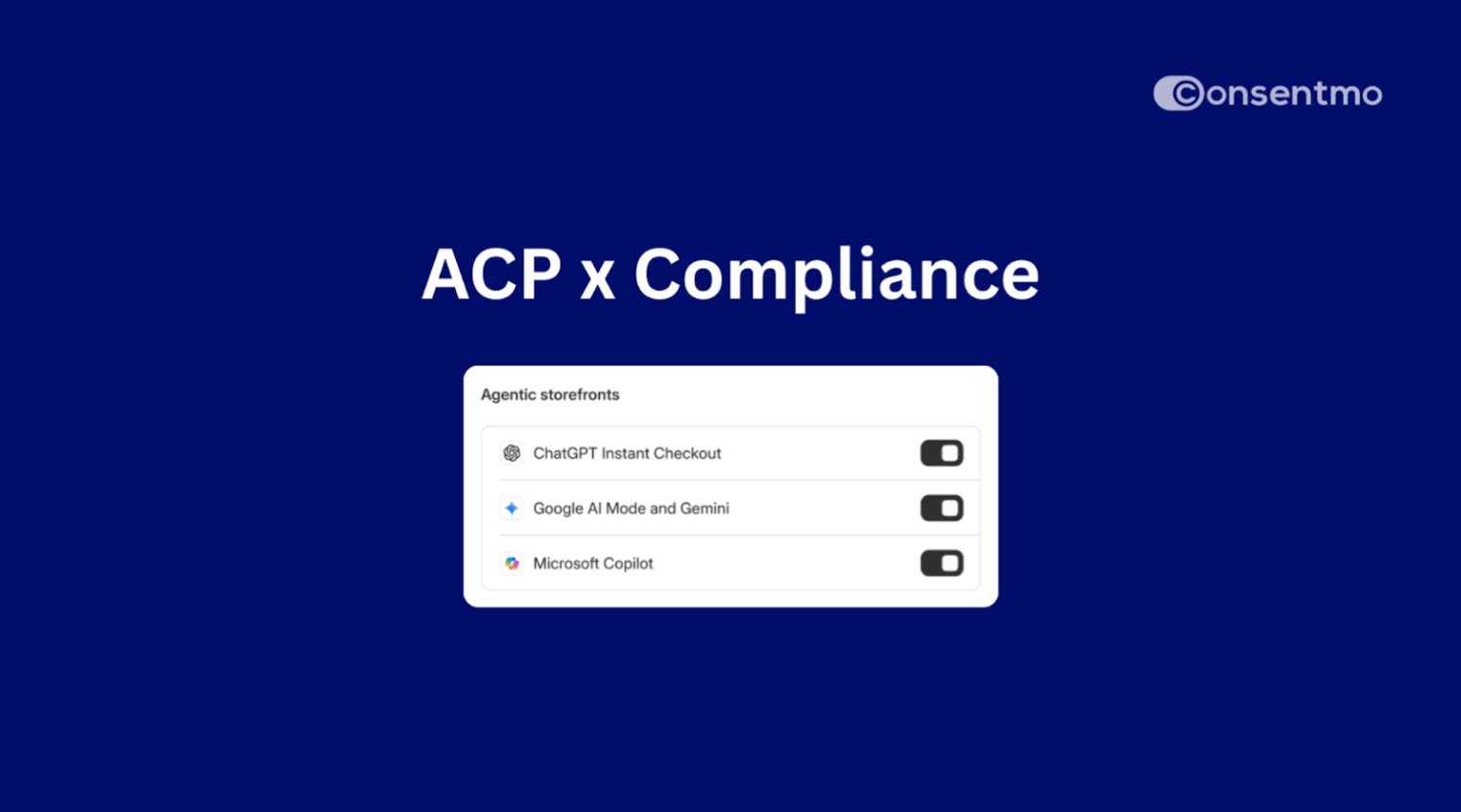
This isn't a hypothetical future. OpenAI's ChatGPT Instant Checkout, powered by the Agentic Commerce Protocol (ACP) developed with Stripe, is making this a reality. And it raises a fundamental question that every Shopify merchant using consent management tools like Consentmo needs to answer:
How do you obtain and honor consent when the customer never sees your consent interface?
The Compliance Challenge, Simplified
Traditional e-commerce consent flows assume a browser-based journey. Customer visits your site, cookie banner appears, choices are recorded, and data processing follows those preferences. Simple enough.
Agentic commerce breaks this model entirely.
When an AI agent completes a purchase on behalf of a user, the transaction happens through APIs and backend systems. The customer interacts with ChatGPT, not your storefront. Your carefully configured consent banner never triggers. Your analytics pixels have no browser to fire in. Your marketing cookies have nowhere to land.
Yet you still have GDPR and CCPA obligations. You still need lawful bases for processing. You still need auditable records.
The question isn't whether to comply - it's how.
The Conservative Default: When in Doubt, Block It Out

After analyzing the regulatory landscape, technical constraints, and risk profiles, one principle emerges clearly:
Treat agentic channels as no-consent channels for non-essential data processing by default.
This means:
Allowed under contractual necessity:
- Order fulfillment data
- Payment processing
- Shipping and delivery information
- Transactional emails (order confirmation, shipping updates)
Blocked without explicit consent:
- Analytics tracking
- Marketing cookies and pixels
- Behavioral profiling
- Third-party data sharing
- Promotional emails
- Personalization based on browsing history
This isn't overcautious, but it is the only defensible position when you have no mechanism to collect consent at the point of transaction.
Differentiating Orders: Storefront vs. Agentic
The first practical challenge is identification. How does your Shopify admin - and your compliance tooling - know which orders came through traditional checkout versus AI-assisted purchase?
Shopify's order object will likely include signals such as a new source name value indicating agentic checkout, channel information identifying the AI assistant platform, automatic tags marking AI-assisted orders, note attributes containing ACP session metadata, and modified client details reflecting the non-browser nature of the transaction.
Smart compliance solutions should implement composite signal detection rather than relying on any single field. An order might be identified as agentic if it matches on source name, shows the appropriate channel information, carries relevant tags, lacks typical browser data, or includes ACP-specific note attributes. Requiring at least two matching signals provides confidence while accounting for evolving implementations.
Rethinking Your Consent Records
Here's a question that seems simple but has profound implications:
Should you keep separate consent records for storefront interactions versus agentic checkouts?
The answer is unequivocally yes - and not just as a best practice. Separate records are essential for legal compliance, audit defensibility, and accurate responses to data subject access requests.
Consider what happens when a customer submits a DSAR asking how their data was collected and processed. If all your consent records look identical regardless of channel, you cannot accurately explain that their agentic purchase was processed under contractual necessity with non-essential processing blocked, while their later storefront visit resulted in explicit consent for marketing communications.
Your consent log schema needs to evolve to capture this context.
A New Consent Log Schema for Agentic Commerce
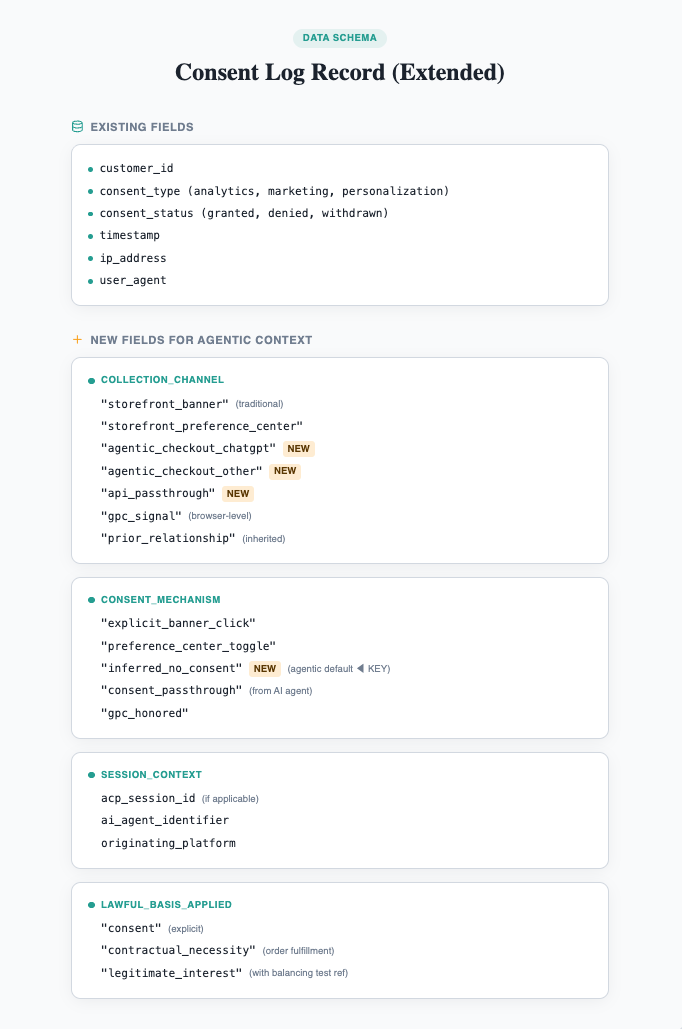
Traditional consent records capture the basics: customer identifier, consent type, status, timestamp, and technical details like IP address and user agent. For agentic commerce, this isn't enough.
The extended schema should include three new categories of information.
Collection Channel identifies where consent was obtained or inferred. Values should distinguish between storefront banner interactions, preference center updates, agentic checkout through ChatGPT or other platforms, API passthrough mechanisms, GPC signals, and inherited consent from prior relationships.
Consent Mechanism describes how the consent status was determined. This differentiates between explicit banner clicks, preference center toggles, inferred no-consent for agentic defaults, consent passthrough from AI agents, and honored GPC signals.
Session Context captures the technical details of agentic transactions, including ACP session identifiers, AI agent identification, and originating platform information.
Additionally, each record should explicitly document the lawful basis applied - whether consent, contractual necessity, or legitimate interest with reference to the balancing test performed.
This extended schema transforms your consent log from a simple record of preferences into a comprehensive audit trail that can withstand regulatory scrutiny.
The Consent Decision Tree
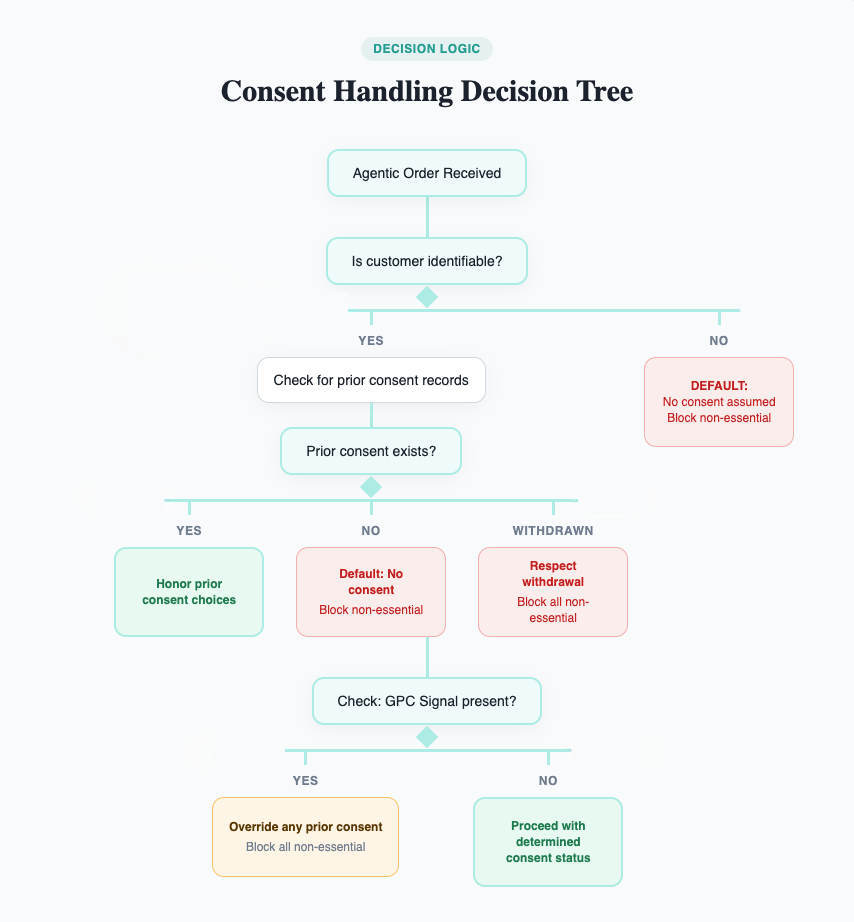
When an agentic order arrives, your compliance system needs to make intelligent decisions about what processing is permitted. The logic should follow a clear hierarchy.
First, check for GPC signals. Global Privacy Control represents an explicit opt-out that overrides everything else. If present, block all non-essential processing and log the decision as GPC-honored.
Second, evaluate essential processing. Data required for order fulfillment - payment processing, shipping, transactional communications - proceeds under contractual necessity regardless of consent status. No consent is needed, but the lawful basis should be documented.
Third, look for prior consent. If the customer is identifiable and has previous consent records from storefront interactions, those preferences can be honored. A returning customer who previously opted into marketing emails can continue receiving them, even for agentic orders. Log this as inherited prior consent with reference to the original consent date.
Fourth, apply the default. For new customers or those without prior consent records, block all non-essential processing. Log this as inferred no-consent with the reason noted as agentic channel default.
This hierarchy ensures consistent, defensible decisions while respecting legitimate prior preferences.
The New Customer Journey: Four Consent Opportunities
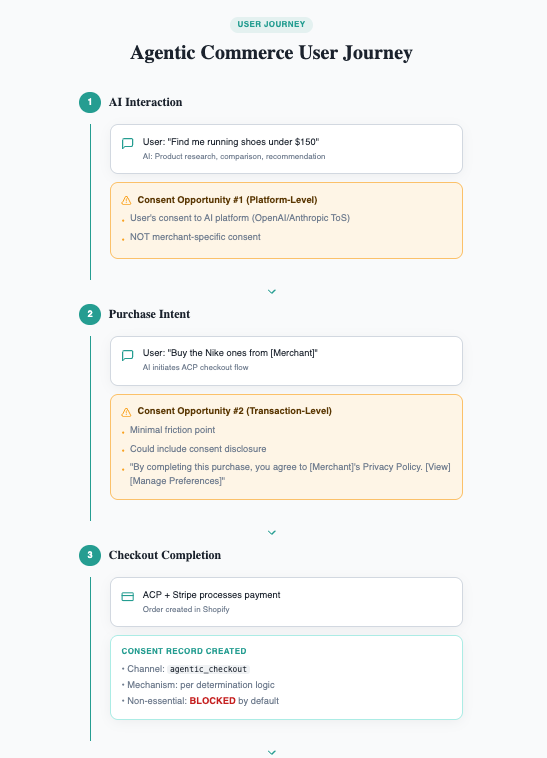
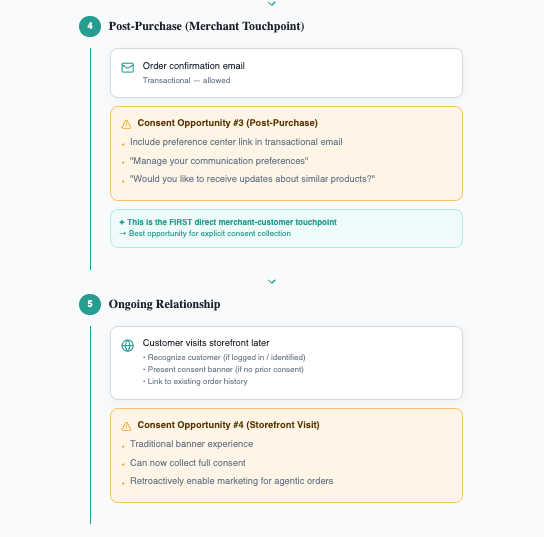
Agentic commerce doesn't eliminate consent collection - it redistributes it across different touchpoints. Understanding this new journey reveals where and how consent can be obtained.
Opportunity One: Platform-Level Consent
When a user interacts with ChatGPT or another AI assistant, they've consented to that platform's terms of service. This covers the AI's data processing but does not extend to individual merchants. You cannot rely on OpenAI's consent for your marketing purposes.
Opportunity Two: Transaction-Level Disclosure
During the checkout flow, the AI agent could theoretically present merchant-specific consent options. The user might see a message indicating that by completing the purchase, they agree to the merchant's privacy policy, with options to view details or manage preferences.
This capability doesn't exist in standardized form today, but compliance solutions should build infrastructure to receive such signals when they become available.
Opportunity Three: Post-Purchase Consent
The order confirmation email represents your first direct touchpoint with the customer. This is your best current opportunity for consent recovery.
The email should acknowledge the agentic context transparently. Consider messaging that explains the purchase was made through an AI assistant, so you don't yet have their communication preferences. Offer clear options to opt into updates, decline, or manage preferences in detail. Emphasize that their data is only used for order fulfillment unless they choose otherwise.
This approach respects the customer's intelligence, provides genuine value, and creates a compliant path to expanded data processing.
Opportunity Four: Subsequent Storefront Visits
If an agentic customer later visits your website directly, your standard consent banner should appear. Their choices at this point can be linked to their existing customer record, potentially enabling marketing for past and future orders.
The key is maintaining a unified consent record system that connects these touchpoints to a single customer identity.
Implementation Priorities for Compliance Solutions
For consent management platforms adapting to agentic commerce, the following priorities emerge:
Immediate priorities include building reliable agentic order detection using composite signals, implementing default no-consent posture for non-essential processing, and extending consent log schemas to capture channel and mechanism context.
Near-term priorities involve creating separate reporting views for agentic versus storefront consent rates, developing post-purchase consent collection email templates, and building infrastructure to receive consent passthrough signals from AI agents.
Longer-term priorities include monitoring ACP and Shopify developments for standardized consent signaling, preparing for potential regulatory guidance specific to AI-mediated commerce, and developing merchant education resources for this new paradigm.
Implementation Priorities for Merchants
Shopify store owners should focus on several key actions:
Update your privacy policy to explicitly disclose AI-assisted purchase pathways. Customers should understand that orders may be placed through third-party AI assistants and what that means for their data.
Separate your email streams rigorously. Transactional emails (order confirmation, shipping updates) are permitted under contractual necessity. Marketing emails require consent. Never bundle promotional content into transactional messages for agentic orders.
Review your pixel and analytics configuration. Ensure that tracking only fires when consent has been obtained. Agentic orders processed without storefront interaction should not trigger analytics or advertising pixels.
Work with your compliance solution to ensure agentic orders are properly tagged and that consent records accurately reflect the collection channel.
Design your post-purchase flow to recover consent gracefully. The order confirmation email is your opportunity to build a consented relationship with customers who discovered you through AI.
Open Questions for the Industry
Several significant questions remain unanswered as agentic commerce matures:
Will ACP develop consent passthrough standards? For EU compliance at scale, some mechanism for AI agents to collect and transmit merchant-specific consent seems necessary. The technical specifications don't currently address this.
How will Shopify formally document agentic order attribution? Merchants and compliance solutions need official documentation on how to reliably identify AI-assisted orders. Current approaches rely on inference and pattern matching.
Will regulators issue specific guidance? GDPR and CCPA were written before AI agents could complete purchases. Regulatory clarification on how existing principles apply to agentic commerce would benefit everyone.
How will GPC signals propagate through AI transactions? A user with GPC enabled in their browser has expressed a clear privacy preference. How that signal reaches merchants when the browser isn't involved in the transaction remains technically unresolved.
The Competitive Landscape: A Brief Note
It's worth observing that different AI platforms are taking different approaches to commercial integration.
OpenAI has announced advertising in ChatGPT and is actively building commerce capabilities through ACP. This creates potential conflicts of interest - will product recommendations be influenced by advertising relationships? - and adds complexity to the compliance picture.
Anthropic has positioned Claude explicitly as ad-free and user-aligned, emphasizing that recommendations serve user interests without commercial influence. Their recent Super Bowl campaign made this distinction memorably clear.
For merchants, this competitive dynamic matters less than the practical reality: customers will use various AI assistants, and your compliance posture needs to work regardless of which agent facilitates the purchase.
Conclusion: Building for an Uncertain Future
Agentic commerce is here, and it's growing. The merchants and compliance solutions that adapt thoughtfully will be positioned for success; those that ignore the shift risk both regulatory exposure and customer trust erosion.
The principles are clear even when the specifics are evolving:
Default to privacy protection when consent cannot be obtained through traditional mechanisms.
Document everything with sufficient context to explain and defend your processing decisions.
Build flexible infrastructure that can accommodate emerging standards for consent signaling.
Recover consent gracefully through post-purchase touchpoints that respect customer intelligence.
Stay informed as platforms, regulators, and industry standards continue to develop.
The checkout that never visits your store is no longer theoretical. Your compliance strategy shouldn't be either.
This analysis reflects the current state of agentic commerce as of early 2026. Given the rapid evolution of AI capabilities, platform policies, and regulatory guidance, merchants should monitor developments and adjust their approaches accordingly.