.jpeg)
“We’re experiencing a surge in bot traffic”: A Growing Shopify Problem
Over the past few weeks, a clear pattern has been emerging across the Shopify community.
Store owners are reporting a sharp increase in bot traffic — fake sessions, abandoned checkouts filled with fake data, and sudden drops in conversion rates. For many, the spike began immediately after Cyber Monday and has continued onwards.
What makes this difficult to pinpoint is that much of this traffic looks legitimate at first glance. Modern bots can load pages, execute JavaScript, and follow normal user paths, which allows them to bypass basic blockers and blend into analytics as real visitors.
If your store has seen more traffic but fewer completed purchases since major sales events, this isn’t a coincidence or seasonal noise. Bot activity has become more aggressive, more persistent, and far more capable of distorting Shopify performance data during high-traffic periods.
.png)
TL;DR
- Shopify stores often see bot traffic spikes after major sales events like Black Friday and Cyber Monday.
- Bots inflate sessions, abandoned checkouts, and analytics events, causing conversion rates to appear lower than they really are.
- Common protections (IP blocking, checkout protection, firewalls, CAPTCHAs) help, but often act too late in the user journey.
- Bots frequently interact with cookie banners, triggering consent and tracking signals that pollute analytics and ad platforms.
- Adding bot detection at the consent layer helps ensure only real users generate consent, analytics, and advertising signals.
Why Bot Traffic Spikes After Big Sales Events Like BFCM
Large-scale promotions create the perfect conditions for bot activity.
Since traffic volumes are overall higher, it is easier for automated traffic to blend in without immediately triggering alarms. For bots designed to scrape data, test payment methods, or probe store infrastructure, these periods offer both scale and cover.
There are several common reasons bots target Shopify stores after large campaigns:
- Price and inventory scraping to track discounts and stock levels in real time
- Card testing and fraud attempts using checkout and payment flows
- Ad and analytics manipulation, where bots trigger events that pollute attribution models
- Competitor monitoring, tracking product changes and promotional strategies
The result is a wave of non-human sessions that behave convincingly enough to pass basic filters — but leave behind distorted data, abandoned checkouts, and declining conversion metrics once the sale period ends.
Why Running Ads Can Increase Bot Traffic
Merchants also point out an important factor: running ads often attracts more bots to your store.
Paid campaigns create an easy entry point for traffic. Bots routinely scan ad platforms to:
- Click ads to trigger analytics and conversion events
- Manipulate attribution models
- Scrape landing pages linked to active campaigns
- Test tracking and consent behavior on high-traffic URLs
Because ad clicks are designed to look like real user actions, this traffic can be especially difficult to filter. Bots arriving via ads often:
- Load landing pages normally
- Interact with cookie banners
- Trigger analytics and advertising events
- Exit without purchasing :(
.jpeg)
This creates a double impact: ad spend is wasted, and no valuable conversions are actually made on the store. Over time, this can lead to weaker campaign optimization and misleading performance insights.
For stores running paid traffic during high-volume periods, protecting early interaction points like the consent layer (cookie banner) becomes even more important to ensure ad platforms are learning from real customers, not spam.
Common Solutions Merchants Use to Handle Bot Traffic Surges
When bot traffic spikes, most Shopify merchants respond quickly — and understandably — by adding protective layers wherever possible. The most common approaches fall into a few categories.
1. Checkout and Payment Protection
Most useful for: Securing transactions and stopping fraud.
These tools are absolutely non-negotiable for e-commerce. They successfully block card testing, synthetic identity fraud, and rapid checkout submission, saving you money and chargeback headaches.
It is possible that some of your analytics may still be distorted from bot traffic. The protection starts at the end of the journey when bots may have already inflated your Abandoned Checkout and Visitors metrics, meaning your conversion rate data is still inaccurate.
2. Dedicated Firewall and Bot Protection Apps
Most useful for: Comprehensive store security.
App can provide a necessary, robust layer of defense against high-volume threats, preventing attacks, store hack attempts, and deep scraping. They are your primary security guard.
While they block malicious traffic, many of these systems are optimized for keeping the site online and safe, not for ensuring that every piece of traffic that hits your tracker is human.
.png)
3. CAPTCHAs and Challenge-Based Controls
Most useful for: Securing High-Risk Entry Points.
They are highly effective for locking down specific, high-risk areas like the Login page, Contact Forms, or Account Creation where you absolutely need to verify human presence to prevent spam.
Applying them site-wide or at the cart/checkout causes huge friction. You should use them sparingly and strategically to avoid damaging the user experience and decreasing sales from real customers
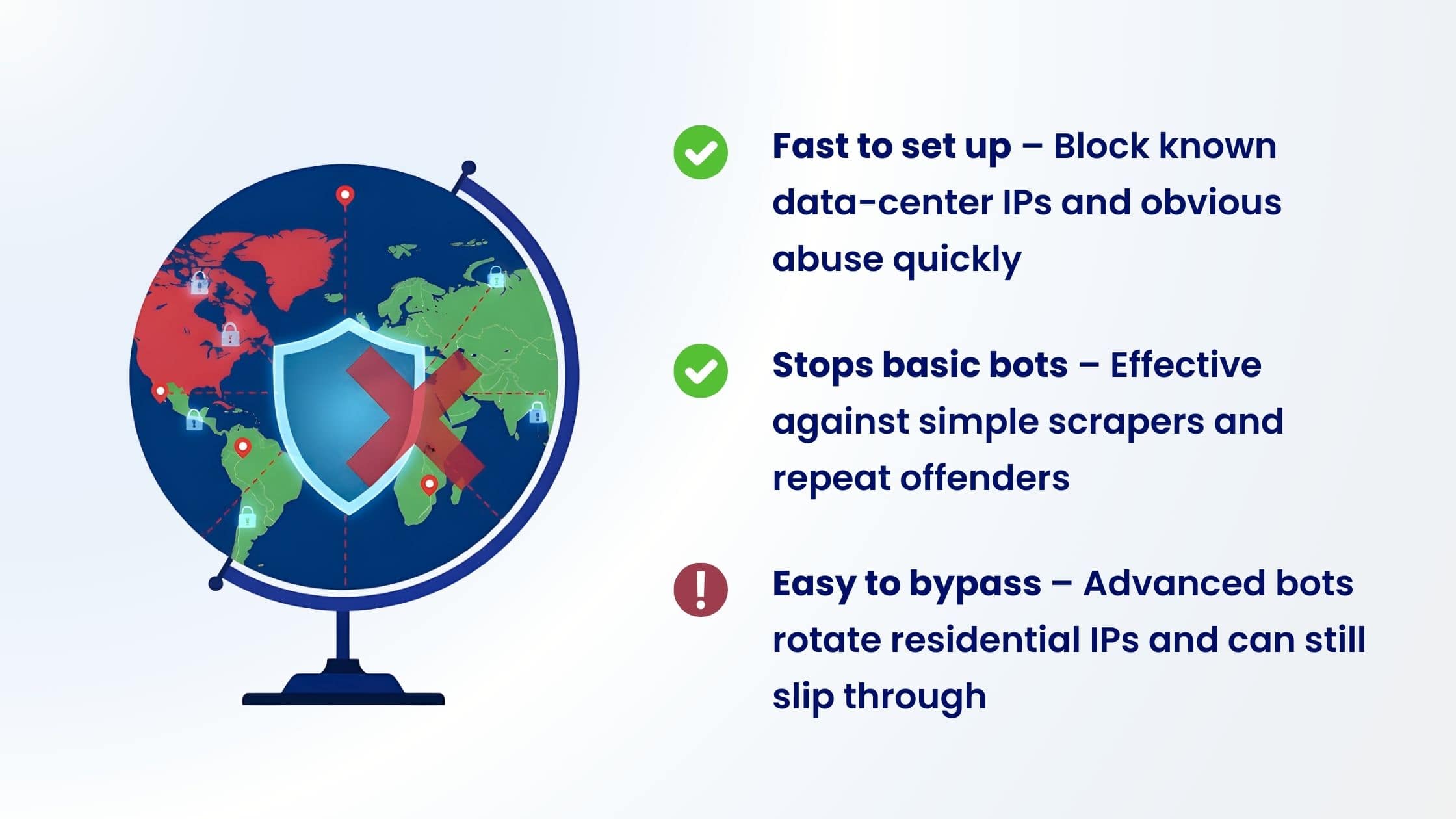
4. IP and Country Blocking
Most useful for: Stopping simple, focused attacks.
This is your best defense against more basic bots, known data-center traffic, or a very specific region that is clearly abusing your site. It's an excellent quick, short-term fix to stop an obvious, repetitive attack.
However, it requires manual effort and management. Modern bots use rotating IPs and proxies, making single IP blocking tricky. At the same time - blocking too aggressively risks false positives, stopping legitimate customers who share an IP range with a bot.
Same goes for country blocking. Use this wisely only if you are sure you normally get little to none customers from the region you want to block. Once you decide to stop traffic from it - set a reminder somewhere to come back and unblock the region just to make sure you are not missing out on customers once the surge is over.
Each of these solutions plays a role, and many merchants use several at once. However, most of them focus on blocking access or preventing fraud, rather than ensuring that only real users are counted as real users throughout the store’s data and consent flows.
That gap becomes especially important at the earliest interaction points — before analytics, ads, and consent signals are triggered.
Bots Are Interacting With Your Cookie Banner
One area that often remains unprotected during bot surges is the cookie banner.
Cookie banners show as soon as a shopper visits your store. For bots that are designed to mimic real visitors, they can still view the banner, trigger accept or reject actions, and continue navigating the store as if they were legitimate users.
When this happens, the effects go beyond compliance. Bots that interact with the consent layer can:
- Inflate consent analytics
- Activate tracking and advertising scripts (Google Analytics, Facebook pixel, etc.)
- Appear as valid, consented users in tracking systems
- Pollute consent logs with non-human interactions
- Further distort session, funnel, and conversion data
Because these interactions happen before checkout — and often before merchants notice anything unusual — they quietly influence analytics and reporting across the entire store.
This makes the consent banner one of the earliest and most important places to prevent automated traffic from being counted as real customer behavior.
A Practical Solution: Cookie Banner Bot Protection by Consentmo
Consentmo is already the first piece of code that loads on your storefront to manage cookie consent and ensure compliance with GDPR, CCPA, and other privacy laws. This unique position makes it the perfect gatekeeper for your traffic.
Consentmo includes bot detection and protection at the cookie banner level, helping prevent non-human traffic from interacting with consent choices in the first place. When bots are detected, they are blocked from accepting or rejecting cookies, ensuring that consent logs, analytics signals, and advertising platforms track real users only.
By enabling Bot Protection for your cookie banner, merchants essentially:
- Maintain accurate consent analytics (Accept, Reject, etc.)
- Reduce polluted data and fake signals for ads and analytics
- Improve the reliability of conversion and funnel data
- Complement existing bot protection and fraud-prevention tools
By implementing Consentmo's bot detection, you move from passively reacting to bot problems (like cleaning up abandoned checkouts) to proactively filtering traffic right at the entrance of your store.
You can easily activate this feature straight from the Behavior setting of your Cookie Banner:
.png)
Conclusion
Bot traffic can significantly distort Shopify performance data, making healthy stores appear to underperform.
While checkout and payment protections are essential, they act too late to prevent bots from inflating sessions, abandoned checkouts, and analytics events.
Because cookie banners load at the start of every session and directly control tracking and consent signals, they represent one of the earliest and most effective points to filter non-human traffic. Protecting this layer helps ensure that analytics, advertising platforms, and performance decisions are based on real customer behavior. One way to protect your banner is by activating the Bot Protection feature by Consentmo.
As bot activity becomes more advanced, reacting after the damage is done is not enough. Merchants who protect early interaction points gain clearer data, more reliable insights, and better control over how their store truly performs.