Most merchants don’t notice data loss right away.
Sales keep coming in. Orders look normal. Nothing crashes. But reports start to feel… off.
Google Ads shows fewer conversions than expected. Analytics doesn’t quite match backend revenue. Campaigns that used to perform steadily start drifting.
At first, it’s easy to blame seasonality. Or competition. Or creatives.
In reality, what’s often missing isn’t performance - it’s visibility.
TL;DR (straight answer)
- Without Google Consent Mode, expect 30–60% visibility loss in GDPR regions.
- The store still performs; reporting doesn’t.
- Google Ads optimization is affected first.
- The longer it runs this way, the harder it is to recover cleanly.
Now let’s talk about what “data loss” actually means.
What data loss really looks like in practice
When merchants hear “data loss”, they imagine something dramatic.
Orders disappearing. Revenue dropping. Customers vanishing.
That’s not what happens.
What actually happens is quieter - and more dangerous.
You still get sales but Google doesn’t see them correctly.
Conversions don’t get attributed. Campaigns lose feedback. Reports stop reflecting reality. Decisions get made on partial information.
Nothing breaks loudly. It just erodes slowly.
Why Consent Mode makes such a big difference
When a visitor rejects cookies, tracking must stop. That part is non-negotiable.
The difference is what Google understands about that rejection.
Without Google Consent Mode:
- Google receives nothing
- It can’t tell whether tracking was blocked by consent or broken entirely
- Missing data looks like poor performance
With Consent Mode:
- Google understands why data is missing
- Anonymous signals may still be used (depending on setup)
- Modeling becomes possible
That distinction is what keeps reporting usable.
If you want to revisit how this works technically, it’s explained step by step in Google Consent Mode v2: what it actually does (explained in plain English).
Typical data loss ranges merchants see
Exact numbers vary by traffic source, region, and setup - but patterns are consistent.
Stores operating in GDPR regions usually see:
- No Consent Mode at all
Roughly 40–60% of conversions never make it into Google Ads or Analytics. - Basic Consent Mode
Around 25–40% visibility loss. Clean compliance, but limited modeling. - Advanced Consent Mode
Often closer to 10–20% modeled gap. More stable reporting, more complexity.
These aren’t guarantees. They’re real-world ranges observed across many Shopify stores.
The key point: without Consent Mode, the gap is usually much larger than merchants expect.
Why Google Ads feels the impact first
Analytics issues tend to creep in slowly.
Google Ads doesn’t wait.
Ads depend on feedback loops - conversions informing bids, audiences, and optimization. When that loop breaks, performance drifts even if demand hasn’t changed.
That’s why many merchants first notice:
- Rising CPAs
- Learning phases that never settle
- Campaigns that “just don’t scale anymore”
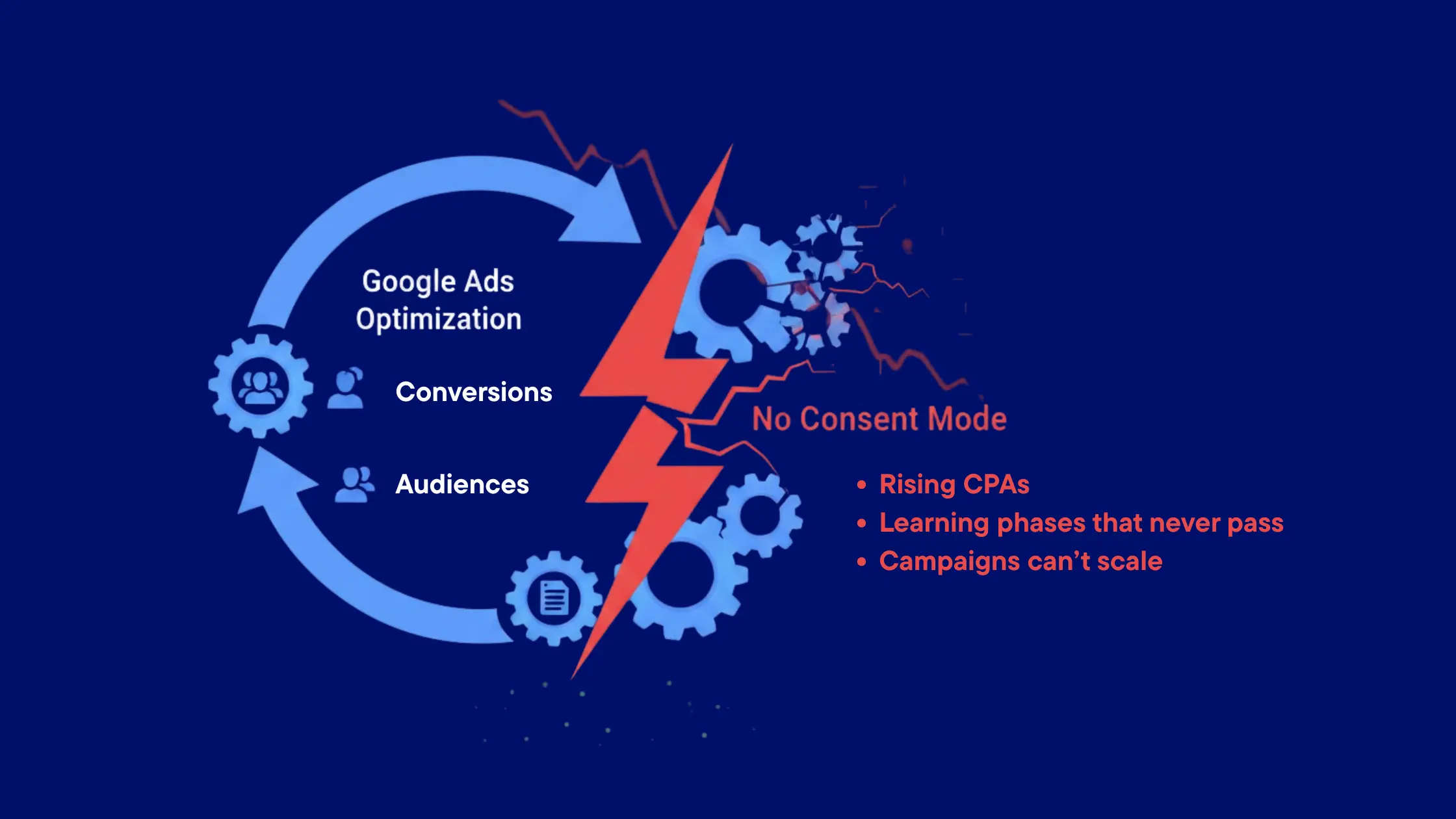
The issue may not be the ads themselves but the signals behind them.
The hidden problem: false confidence
One of the most common (and risky) situations we see is this:
“We already have a cookie banner, so we’re fine.”
A banner alone doesn’t tell Google anything.
Without Consent Mode, Google can’t distinguish between:
- a user who rejected tracking
- a broken or missing implementation
That’s where false confidence sets in - everything looks compliant, but tracking logic doesn’t line up with user choice.
This is exactly why Consent Mode needs to be configured through a CMP like Consentmo. Inside the app, merchants don’t just add a banner - they ensure consent is captured first, Google tags react correctly, and the right signals are sent consistently.
That consistency is what prevents silent data loss.
Why the impact grows over time
Data loss isn’t a one-day event - it compounds.
The longer Google Ads operates on incomplete feedback:
- The weaker optimization becomes
- The harder it is to trust historical data
- The more guesswork enters decision-making
Fixing Consent Mode later helps - but recovery isn’t instant. Models need time to relearn.
That’s why waiting until performance drops is often too late.
What this means for your store
If your reports feel “lighter” than your actual revenue, you’re probably not imagining it.
Data loss doesn’t mean your store is failing. It means your measurement is.
And measurement is what guides everything else.
If you want to understand the consequences of skipping Consent Mode entirely - not just data loss, but enforcement risk - that’s covered in What happens if you don’t implement Google Consent Mode v2 at all?
The takeaway
Consent doesn’t just change what you’re allowed to track, it changes how platforms interpret what they don’t see.
Google Consent Mode is what gives that missing data context. Without it, you’re flying with partial instruments - still moving, but guessing more than you realize.
Once you see it that way, the question isn’t whether data loss exists. It’s how much of it you’re willing to accept.
Take control of your tracking and stabilize your Google Ads performance by enabling Google Consent Mode v2 directly within Shopify with Consentmo.