_converted.avif)
If you sell wine in a gift box, nicotine products, adult goods, or anything else with an age limit, you have probably asked the same question: do I need an age verification popup on my Shopify store?
You are not alone. The answer depends on what you sell, where your shoppers are, and whether they are only browsing or already at checkout and delivery. Some stores only need a clear “confirm your age” screen on certain collections. Others sit in categories where photo ID, delivery checks, or stronger age assurance still apply on top of any popup.
This guide walks through that in plain language. First, the product side: alcohol, tobacco and vapes, cannabis where it is lawful, CBD and hemp, adult products and content, knives and other regulated goods, gambling experiences, and mixed catalogs where only part of the store is restricted. Then the country and regional side: selected rules in the United States, United Kingdom, European Union and France, Canada, and Australia, with links to primary sources so you can see what regulators actually say.
You will also see where a simple self-declared popup is a solid first line on the storefront, and where the law still expects more than an “I am 18+” click. Near the end, we introduce Consentmo Age Gate, our Plus feature for regional age rules, path targeting, and a store-matched gate, with honest limits on what it does and does not cover.
Use this as a practical map for your catalog. It is not legal advice. For final decisions in your markets, check with a lawyer who knows your products and locations.
What an age verification popup actually does
Merchants use “age verification popup” for several different things:
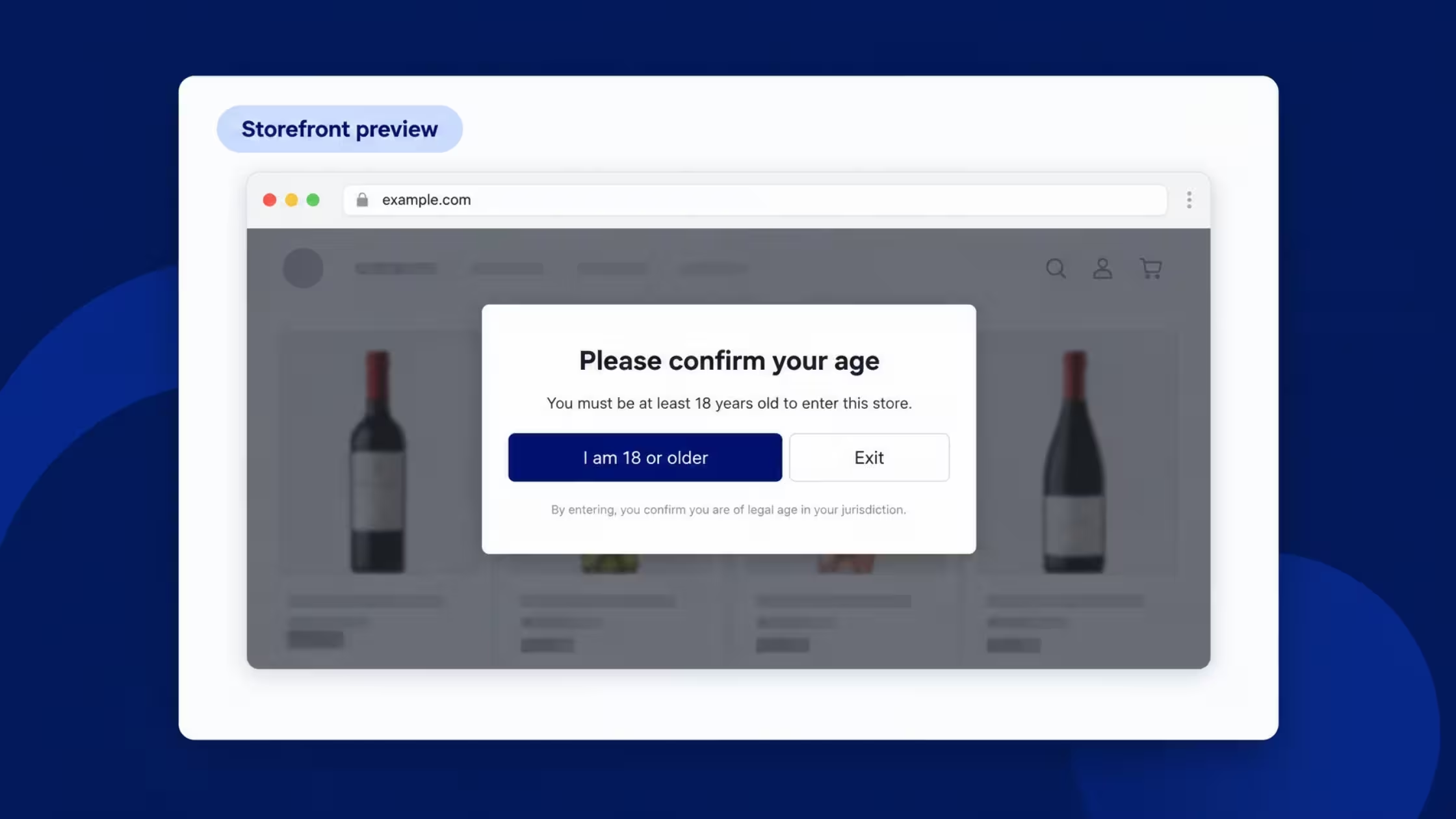
- Self-declared age gate. Confirm button, date of birth, or birth year before the visitor sees the store or a path. No government ID.
- Neutral age screen (privacy context). Free entry of age/DOB used to route under-13 users under children’s privacy rules (for example COPPA-style screening).
- High-assurance age verification. Photo ID match, facial age estimation, open banking, credit-card checks, mobile operator checks, digital identity, and similar methods regulators treat as capable of being “highly effective.”
- Point-of-sale / delivery checks. Photo ID at purchase, carrier age-on-delivery, FFL transfer rules, licence conditions.
A popup or full-page gate on Shopify usually covers (1) and sometimes supports (2). It rarely satisfies (3) or (4) on its own. That distinction drives every product and country example below.
Products and categories that commonly need a gate
Legal duty always depends on product, service, delivery method, and visitor location. The table groups typical merchant scenarios.
Practical Shopify pattern: gate only /collections/alcohol or selected product URLs when the rest of the catalog is unrestricted. Full-store gates fit pure adult or pure alcohol brands.
Country and regional rules (selected examples)
These examples show when age restrictions or stronger assurance matter. They are not an exhaustive legal map.
United States: tobacco and nicotine
Federal Tobacco 21 makes it illegal to sell tobacco products, including e-cigarettes and nicotine from any source covered by the law, to anyone under 21. FDA’s final rule states that beginning 30 September 2024, retailers must use photo ID to verify age for anyone under 30 attempting to buy cigarettes, smokeless tobacco, and covered tobacco products. FDA also inspects online retailers.
Sources: FDA Tobacco 21, FDA final rule announcement.
Store implication: An age popup can set expectations and block casual underage browsing. It does not replace required photo-ID verification for covered tobacco sales.
United States: firearms (high level)
ATF guidance for federal firearms licensees sets different minimum ages for handguns/handgun ammunition versus long guns/long-gun ammunition, with FFL transfer and background-check duties separate from any website UI.
Source: ATF: Minimum age for gun sales and transfers.
Store implication: A gate can reduce underage storefront access. It is not an FFL or NICS substitute.
United States: adult websites (state laws)
Multiple states (Louisiana led early; Texas, Florida, and others followed) require covered pornography sites to use reasonable / commercial age verification, often pointing to digital ID, government ID, or transactional data rather than a bare “I am 18” click.
Store implication: A self-declared Consentmo-style gate alone should not be marketed as satisfying those adult-content statutes.
United States: COPPA (children’s privacy, general-audience services)
For operators that use age screening on general-audience services, the FTC expects a neutral age-screening mechanism and advises against designs that encourage falsification. FTC staff state that a checkbox such as “I am over 12” is not a neutral age-screening mechanism.
Source: FTC: Complying with COPPA – FAQs.
Store implication: Date-of-birth or birth-year entry can support a more deliberate screen than a bare confirm button. COPPA parental-consent and children’s-data duties remain separate from a product age gate.
United Kingdom: alcohol (remote sales)
UK licensing policy treats remote alcohol sales as needing age-verification measures online, with further checks before physical delivery under the Licensing Act framework.
Store implication: Online gates help the digital layer; delivery and licence conditions still apply.
United Kingdom: knives, blades, corrosives (remote sale)
Statutory guidance under the Offensive Weapons Act 2019 addresses age verification for remote sales of knives and related products. Relying only on a purchaser ticking a box or simply stating they are over 18 is widely treated as inadequate for these categories; sellers need an adequate system and compliant delivery practices.
Sources: GOV.UK Offensive Weapons Act 2019 statutory guidance, Business Companion: knives and corrosives.
Store implication: Confirm-button or self-declared DOB alone is a weak fit as the only control for these SKUs.
United Kingdom: pornography and the Online Safety Act
Ofcom requires services that allow pornography to use highly effective age assurance. Methods Ofcom lists as capable of being highly effective include open banking, photo-ID matching, facial age estimation, mobile network operator checks, credit-card checks, digital identity services, and email-based age estimation. Ofcom states that self-declaration of age (and online payments that do not require the person to be 18) are not highly effective. Pornography services faced staged deadlines through July 2025 under Ofcom’s implementation timeline.
Source: Ofcom: Age checks to protect children online.
Store implication: A self-declared Shopify gate may add friction or notice. Do not position it as the required high-assurance mechanism by itself.
European Union / France: adult content
The European Commission has published DSA guidelines on the protection of minors, including guidance on age assurance for restricting access to adult content such as pornography and gambling-related material. In France, authorities and the CNIL have long held that age verification for pornographic sites cannot rest on a simple user declaration of being 18+. Arcom has continued to tighten standards for age verification systems on explicit sites.
Sources: European Commission: guidelines on protection of minors (DSA), CNIL: online age verification.
Store implication: Do not market a basic age popup as full EU/France adult-content age verification.
Canada: tobacco/vaping and cannabis
Federal tobacco and vaping rules set a baseline minimum sales age of 18, while some provinces set higher ages. Adult-use cannabis ages commonly sit at 19 in most provinces/territories, with notable exceptions such as Alberta (18) and Quebec (21).
Sources: Health Canada legislative review context (federal age 18 baseline), Ontario cannabis laws, research summaries on provincial MLA variation (Alberta 18 / Quebec 21).
Store implication: Regional minimum-age rules on the storefront matter. Sale, licence, and identity requirements still sit outside a popup.
Australia: age-restricted online material
Australia’s online safety regime and eSafety materials treat self-declaration alone as ineffective age assurance for covered high-risk services (including pornography). Appropriate assurance can include photo-ID matching, facial age estimation, credit-card checks, or digital identity, depending on the code and service type.
Source: eSafety Age Assurance Issues Paper (PDF).
Store implication: A “I am 18 or older” click is not enough for covered high-risk adult services.
Self-declared popup vs stronger age assurance
Rule of thumb: use a storefront gate for access control and messaging; use licensed processes, carriers, and specialist AV where the statute names them.
Introducing Consentmo Age Gate
Consentmo’s Age Gate is built for Shopify merchants who need a configurable first-line age screen without bolting on a separate single-purpose app for basic gating. It ships on the Plus plan and sits next to Consentmo’s cookie consent, privacy pages, and request flows.
What it does
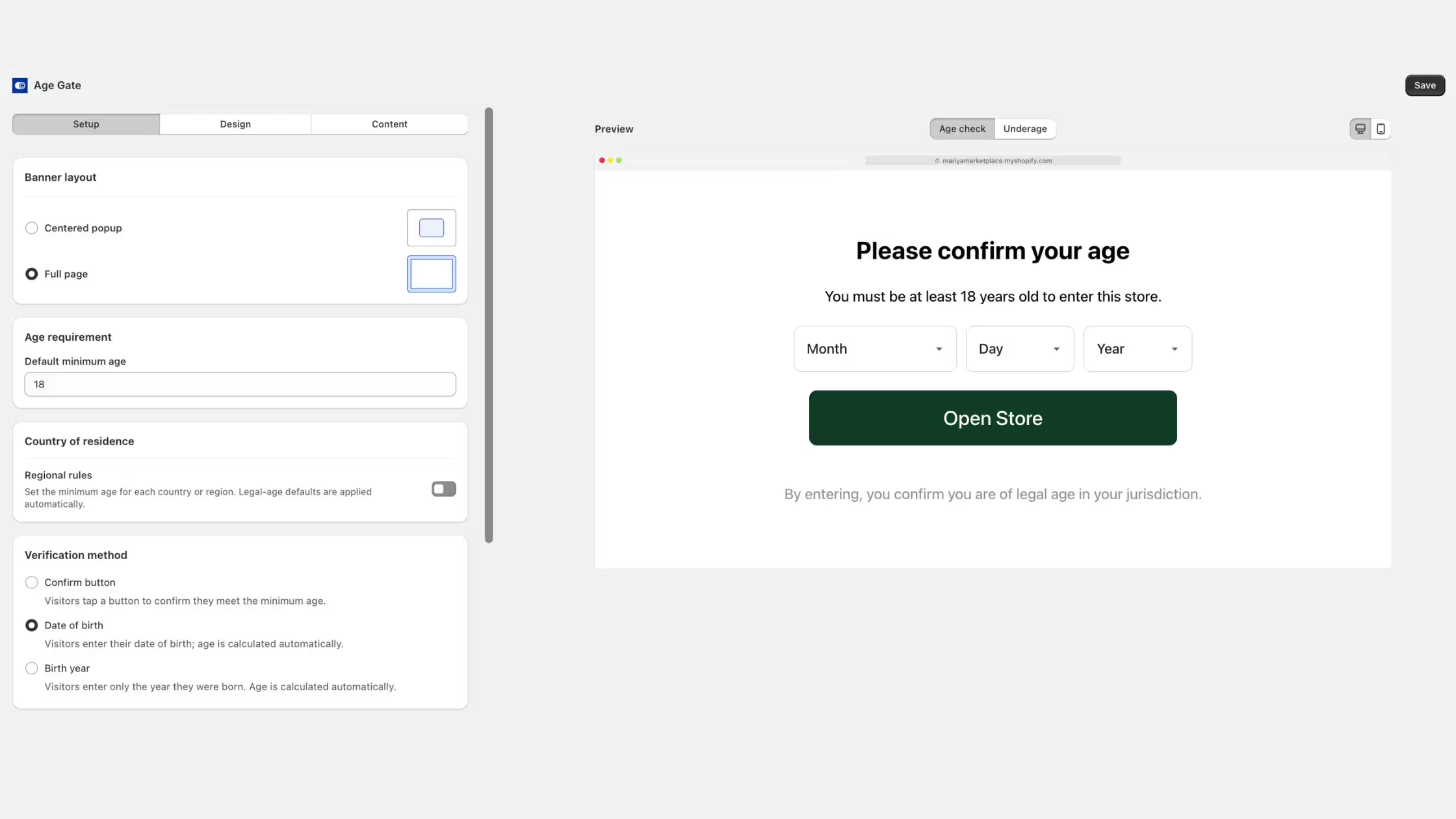
- Flexible coverage. Gate the entire storefront or only selected collections, products, pages, or paths (include/exclude lists). Ideal for mixed catalogs (for example wine inside a gift shop).
- Region-aware rules. Set a default minimum age, then apply different thresholds by visitor location (useful for Canada cannabis ages, alcohol 18 vs 21 markets, and similar splits).
- Verification methods. Confirm button, date of birth, or birth year. All are self-declared inputs calculated in-app.
- Layout and design. Centered popup or full-page gate; colors, logo, custom CSS, and store-matched styling.
- Multilingual content. Title, message, button label, underage text, disclaimer, errors, optional age-policy link; translate for enabled Shopify store languages.
- Remembered verification. Keep a successful check for a configured period so eligible return visitors are not prompted on every page view.
- Safer rollout. Desktop/mobile previews and underage-state previews before you enable on the live storefront.
Setup
- Upgrade to an eligible Plus plan if needed.
- Sidemenu → Age Gate → Set up / Manage.
- Enable the Age Gate by Consentmo app embed.
- Setup: layout, default age + optional regional rules, method, page targeting, remember period.
- Design: colors, logo, custom CSS.
- Content: copy, disclaimer, translations.
- Preview eligible and underage states on desktop and mobile.
- Save, enable, and test paths, languages, and remember behavior on the live store.
How to decide if your store needs a gate
Use this short decision path:
- List restricted SKUs – Alcohol, nicotine, THC, blades, adult SKUs, etc.
- Map visitor markets – US, UK, EU/FR, CA provinces, AU, and any state AV statutes for adult content.
- Separate browse vs buy vs deliver – Popup for browse; ID/KYC/licence for buy; carrier rules for deliver.
- Choose gate scope – Full store vs path-only.
- Choose method friction – Confirm for policy; DOB/birth year when you want a more deliberate self-check.
- Document the gap – Note every duty the gate does not cover and who owns it (ops, carrier, AV vendor, counsel).
- Test underage and regional paths before BFCM or any traffic spike.
If you already run Consentmo for cookies and privacy pages, Age Gate keeps age messaging inside the same compliance stack instead of a disconnected popup app.
Conclusion
Age verification popups show up wherever catalogs meet age-of-sale rules or adult-access policies: alcohol, tobacco and vapes, cannabis where lawful, adult products and content, weapons-related goods, gambling experiences, and mixed stores with only some restricted paths. The country and product pair decides whether a self-declared Shopify gate is enough as a first line or whether photo ID, delivery checks, licences, or highly effective age assurance are mandatory.
Consentmo Age Gate gives merchants regional rules, path targeting, three self-declared methods, design, multilingual copy, and preview tools on Shopify Plus. Use it to control storefront access and set clear expectations, and pair it with the stronger checks your markets still require.
For implementation detail, read the Age Gate product guide or open Age Gate inside Consentmo.